TransData generates realistic order and trade records for exchange-traded derivatives — complete with embedded manipulation patterns and ground-truth labels.
You configure the scenario; TransData produces a fully reproducible, timestamped transaction log with no real member data, no confidentiality risk, and no licensing constraints.
What Makes It Unique
Every output is labeled. Spoofing, wash trading, layering, and momentum ignition are injected by design and tagged at the event level — giving surveillance models the ground truth that real data never provides.
Fully configurable. Control instrument, session length, volatility regime, agent mix, and abuse intensity through scenario files. Every dataset is reproducible from its parameters.
Safe to share. No real orders, no member identities, no proprietary strategies. Use it with vendors, partners, regulators, and new staff without restriction.
Use Cases
Train and benchmark manipulation detection models without touching confidential production data.
Stress-test matching engines, surveillance pipelines, and alert logic against high-load and edge-case flows before deployment.
Run compliance training and regulatory demonstrations using reproducible, documented scenarios.
Methodology
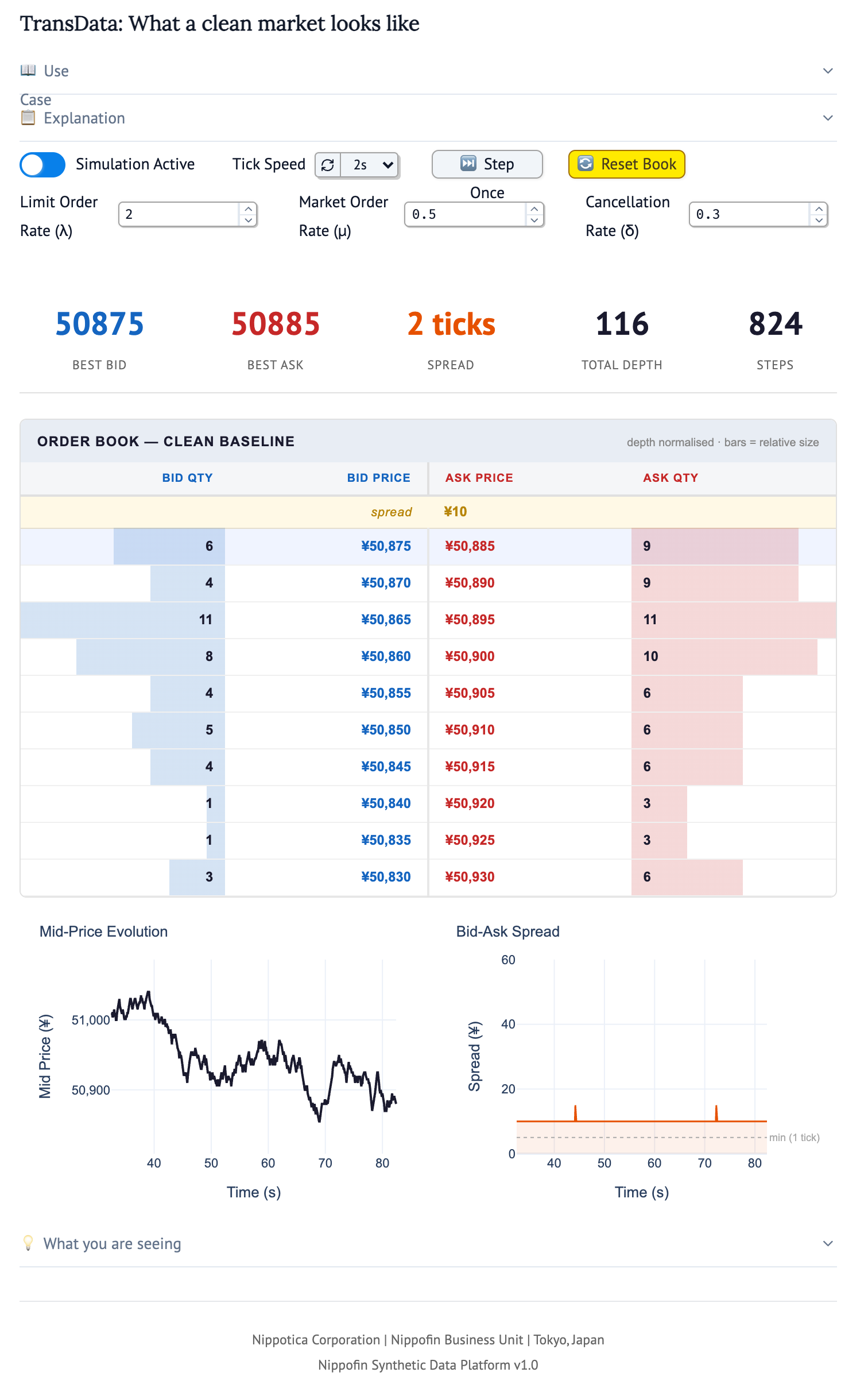
TransData generates a limit order book using statistically calibrated agents whose arrival rates cluster in time — quiet periods punctuated by bursts, the way real markets behave. Abusive agents inject manipulation patterns on top of this baseline at controlled intensities. Every scenario is fully reproducible from its parameter file and random seed. (Roşu, 2009; Bartolozzi, 2010; Cont & Muller, 2021)
We propose an analytically tractable class of models for the dynamics of a limit order book, described through a stochastic partial differential equation with multiplicative noise for the order book centered at the mid-price, along with stochastic dynamics for the mid-price which is consistent with the order flow dynamics. We provide conditions under which the model admits a finite-dimensional realization driven by a (low-dimensional) Markov process, leading to efficient methods for estimation and computation. We study two examples of parsimonious models in this class: a two-factor model and a model in which the order book depth is mean reverting. For each model we perform a detailed analysis of the role of different parameters, study the dynamics of the price, order book depth, volume, and order imbalance, provide an intuitive financial interpretation of the variables involved, and show how the model reproduces statistical properties of price changes, market depth, and order flow in limit order markets.
2010
Springer
A multi agent model for the limit order book dynamics
In the present work we introduce a novel multi-agent model with the aim to reproduce the dynamics of a double auction market at microscopic time scale through a faithful simulation of the matching mechanics in the limit order book. The agents follow a noise decision making process where their actions are related to a stochastic variable, the market sentiment, which we define as a mixture of public and private information. The model, despite making just few basic assumptions over the trading strategies of the agents, is able to reproduce several empirical features of the high-frequency dynamics of the market microstructure not only related to the price movements but also to the deposition of the orders in the book.
This paper presents a model of an order-driven market where fully strategic, symmetrically informed liquidity traders dynamically choose between limit and market orders, trading off execution price and waiting costs. In equilibrium, the bid and ask prices depend only on the numbers of buy and sell orders in the book. The model has a number of empirical predictions: (i) higher trading activity and higher trading competition cause smaller spreads and lower price impact; (ii) market orders lead to a temporary price impact larger than the permanent price impact, therefore to price overshooting; (iii) buy and sell orders can cluster away from the bid-ask spread, generating a hump-shaped order book; (iv) bid and ask prices display a comovement effect: after, e.g., a sell market order moves the bid price down, the ask price also falls, by a smaller amount, so the bid-ask spread widens; (v) when the order book is full, traders may submit quick, or fleeting, limit orders.